The engineering
How diesel–CNG dual-fuel conversion actually works
First, a correction
This is not a “petrol-style” gas conversion
What it is not
Spark-ignition conversion
On a petrol engine you can replace the fuel entirely, because a spark plug provides the ignition source. Your generator’s engine is a compression-ignition (diesel) engine — it has no spark plugs, and at normal diesel compression ratios a lean natural-gas/air mixture will not reliably ignite from compression alone.
What it is
Pilot-ignited dual-fuel retrofit
CNG is mixed into the intake air, and a much smaller quantity of diesel is still injected on every cycle. That diesel “pilot” auto-ignites under compression exactly as it always has — and its flame front then ignites the surrounding CNG–air charge. Two fuels, one combustion event.
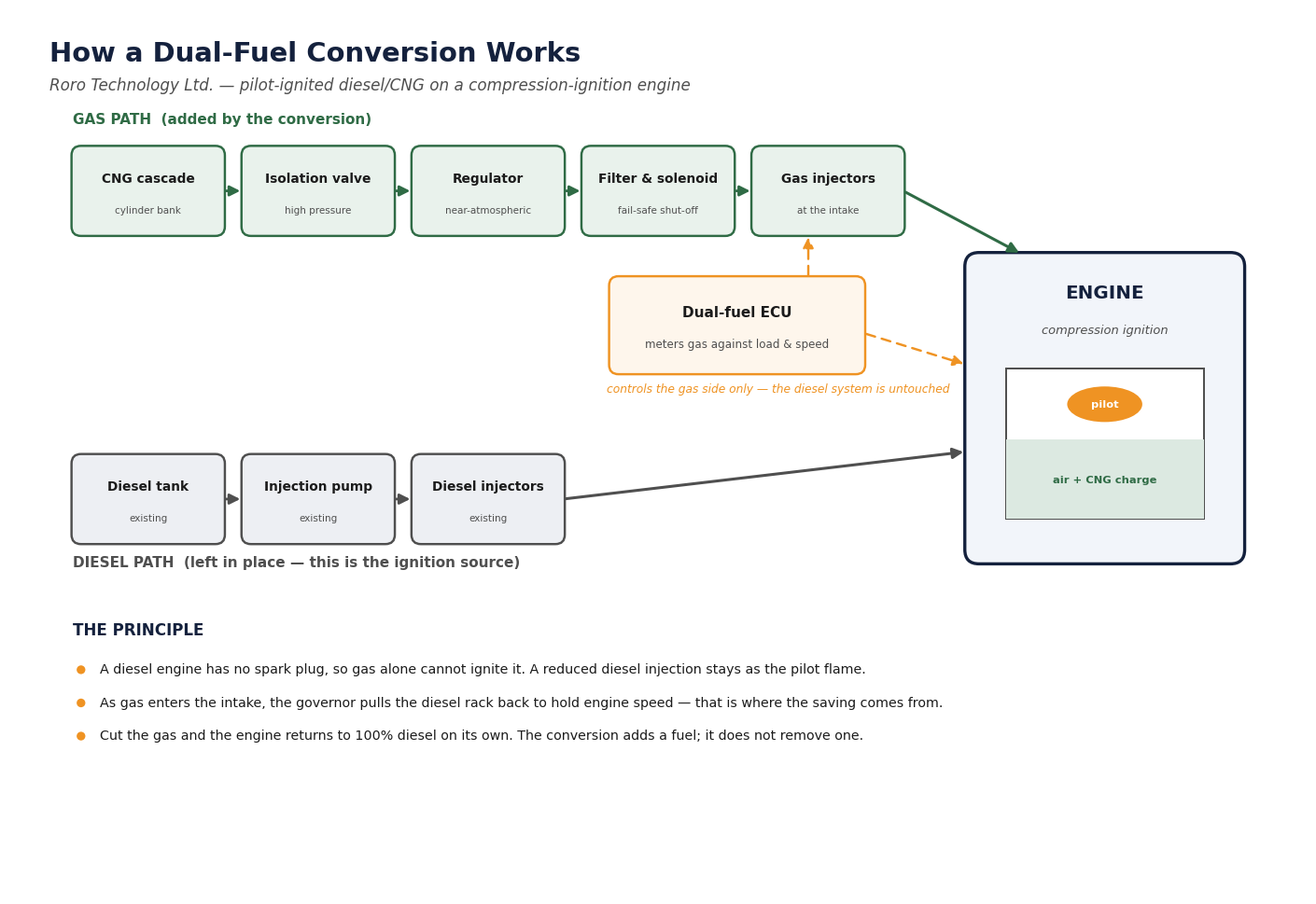
Inside the cylinder
What happens on every engine cycle
- 1
CNG is metered into the intake air
Gas is introduced upstream of the turbocharger or intake manifold, either through a mechanical gas mixer or through electronic gas injectors. It forms a lean, pre-mixed air–fuel charge that is drawn into the cylinder on the intake stroke, exactly like ordinary air.
- 2
The charge is compressed as normal
Nothing about the engine's compression ratio, pistons, or head is modified. The gas–air mixture is simply compressed along with the intake air.
- 3
A reduced diesel pilot is injected and auto-ignites
The original injection system still fires — but delivers substantially less fuel. Under compression, that diesel pilot auto-ignites, providing thousands of ignition points distributed through the combustion chamber.
- 4
The pilot flame ignites the CNG charge
The resulting flame front propagates through the pre-mixed CNG–air charge, releasing the bulk of the cycle's energy from gas rather than from diesel. This is where the cost saving physically originates.
- 5
The controller continuously rebalances the two fuels
A dedicated dual-fuel ECU monitors load, speed, exhaust temperature and — on more advanced kits — knock signals, modulating the gas rate in real time while cutting the diesel quantity proportionally. It always protects a minimum diesel pilot, because below that the engine cannot ignite reliably.
Why this matters for reliability
Because the diesel injection system is retained in full, a dual-fuel engine has an inherent fallback. If gas supply is interrupted — the cascade runs dry, a valve is closed, a sensor faults — the controller simply reverts the engine to 100% diesel operation and it keeps running. You are adding a cheaper fuel path, not removing the existing one.
Setting expectations
Why “70/30” is a duty-cycle average, not a fixed ratio
CNG substitution in a pilot-ignited engine is inherently load-dependent:
- At idle and light load, stable combustion of a lean gas–air charge is difficult. The controller therefore runs the engine on all or nearly all diesel.
- As load rises, substitution rises with it, typically reaching its practical maximum in the 60–100% load band.
- The headline figure is therefore a weighted average across your actual duty cycle, achieved through good load-matching and careful controller calibration.
This is standard behaviour for every pilot-ignited dual-fuel retrofit on the market. A kit that runs mostly on diesel at idle is not underperforming — it is protecting your engine.
It also has a practical consequence: a generator that spends most of its time well loaded will save more than one that idles. If your set is heavily oversized for its load, we will tell you during the survey, because it directly caps the substitution you can expect.
Our substitution policy, by set size
Rather than quote one optimistic number for every engine, we target smaller sets more conservatively.
| Generating set | Target CNG / diesel |
|---|---|
| Below 100 kVA | 50% / 50% |
| 100 kVA and above | 70% / 30% |
What each substitution level is worth
| CNG / diesel split | Cost / L-eq | Saving vs. diesel |
|---|---|---|
| 50% / 50% | ₦1,040 | 38.8% |
| 60% / 40% | ₦908 | 46.6% |
| 70% / 30% | ₦776 | 54.4% |
| 80% / 20% | ₦644 | 62.1% |
The financial model
Where the saving comes from
Step 1 — put both fuels on one energy basis
Diesel has a lower heating value of roughly 35.8–36.4 MJ per litre (≈9.9–10.1 kWh/litre). CNG, being predominantly methane, has a lower heating value of roughly 37–38 MJ per standard cubic metre (≈10.3–10.5 kWh/SCM).
For practical engineering purposes — and consistently with how dual-fuel kit suppliers quote — 1 litre of diesel is treated as approximately energy-equivalent to 1 SCM of CNG. We call that unit a litre-equivalent (L-eq).
Step 2 — blend the price
The dual-fuel cost per L-eq is just the weighted average of the two fuel prices at your substitution split:
At a 70/30 split with diesel at ₦1,700 and CNG at ₦380:
Against ₦1,700 for diesel alone, that is a saving of ₦924 per L-eq — 54.4%.
The key consequence: the percentage is load-independent
Notice that nothing in that calculation refers to your generator’s size, its load, or how many hours it runs. The percentage saving depends only on the fuel price ratio and the substitution split. Your generator size and duty cycle determine the naira amount — how many litre-equivalents you burn to save 54.4% on each one.
What gets fitted
Scope of conversion equipment
Gas train
CNG storage (cylinder cascade sized for your required autonomy), high-pressure isolation valve, pressure regulator/reducer down to near-atmospheric, gas filter, and a fail-safe solenoid shut-off valve.
Fuelling & control
Gas mixer or electronic gas injectors, a dedicated dual-fuel ECU interfaced with the engine's existing governor and injection system, load and speed sensors, and knock sensing for detonation protection where fitted.
Safety systems
Gas leak detection with automatic gas shut-off, forced ventilation as required for the enclosure or canopy, flame arrestors, and NGV-rated cylinders and fittings throughout.
Instrumentation
A substitution-ratio display and data logger, so the CNG displacement actually achieved can be verified against target in service rather than assumed.
Full disclosure
Technical considerations and risks
- Power derating of roughly 3–8%
- CNG carries less energy per unit volume of intake charge than diesel, and a knock-protection margin is normally applied. Dual-fuel engines are therefore commonly derated relative to pure diesel operation. If your set already runs close to its rated output, this needs to be designed around.
- OEM warranty status
- If your generating set is still within its manufacturer warranty period, a retrofit may affect cover. We will help you confirm the terms with the OEM or your local dealer before any work begins, so the conversion is planned in a way that protects you.
- Governor and injection pump interface
- The existing diesel injection system — whether mechanical or electronic — must be compatible with the dual-fuel controller's ability to command a reduced diesel delivery. This is confirmed during the survey, not assumed.
- Gas quality and supply pressure
- Consistent CNG pressure and quality (moisture and particulate content) from your refuelling source directly affects mixer and injector performance. This should be specified to your CNG supplier.
- Methane slip if poorly tuned
- Dual-fuel operation typically reduces particulate matter and CO₂ per unit of energy delivered. However, a poorly calibrated system can increase unburned methane in the exhaust. This is a commissioning and calibration item — which is precisely why calibration is not something to economise on.
Have a question this page didn’t answer?
Our lead engineer would rather talk through the detail than have you commit to something you are unsure about. Send a message and ask.
Or email sales@rorotechnologies.com