Services
From a single generator to a complete gas plant
Advisory
Technical & financial analysis
Before we quote anything, we tell you in writing what a conversion would actually be worth on your specific generating set.
You send us a photograph of your generator’s nameplate. We identify the set, take its prime (continuous) rating as the analysis basis, and issue a formal report covering:
- Equipment identification — every field recorded from the nameplate, so the basis of the analysis is auditable.
- How the conversion works on your engine — the pilot-ignition principle, the scope of equipment, and the recommended CNG substitution target for your set size.
- Projected running costs — diesel-only versus dual-fuel, at low, typical and high usage scenarios, worked daily, monthly and annually.
- A sensitivity table — what the saving becomes if the achieved substitution turns out to be 50, 60, 70 or 80%, rather than only quoting the best case.
- Technical considerations and risks — power derate, OEM warranty status, injection-system compatibility, gas quality, and emissions, stated plainly.
No obligation. The analysis is prepared so you can make an informed decision — including the decision not to proceed. If the numbers do not work for your duty cycle, we will say so.
Advisory
Consultancy & engineering advisory
Engineering judgement, sold on its own — for organisations making a gas decision before they are ready to buy any equipment.
Not every client needs a contractor first. Some need to know whether the project is worth doing at all, what it will cost over its life, and whether the plan somebody else has put in front of them is sound. We take that work on its own terms, and we will advise against a project when the numbers say so — including ours.
Feasibility & demand studies
Gas demand profiling, station sizing, throughput modelling and whole-life cost against the diesel or petrol baseline you are running today.
Fleet transition planning
Which vehicles to convert and in what order, the refuelling infrastructure each phase needs, and the capital profile across the programme.
Owner’s engineer & due diligence
Independent review of another contractor’s design, quotation or built work — for boards, lenders and investors who need a second opinion from people who build these plants themselves.
Regulatory & safety advisory
Permitting pathways, hazardous-area classification, cylinder certification regimes, and operator training built around the standards your site is actually held to.
Advice you can act on without us. A consultancy report is yours. If it concludes you should tender the work competitively, or defer it, or do nothing at all, that is what it will say. We would rather be trusted with the next decision than win this one badly.
Conversion
Car & light vehicle CNG conversion
The biggest percentage saving we deliver anywhere — because a petrol car can run on gas alone.
A petrol engine has spark plugs, so unlike a diesel it does not need a pilot fuel. A converted car is bi-fuel: it runs on 100% CNG while the cylinder has gas, and switches to petrol at the press of a button on the dashboard. Nothing is removed — your petrol tank, injectors and fuel pump all stay exactly where they are.
Because you displace all of the petrol rather than part of it, the saving is far larger than on a diesel truck. At ₦1,300 a litre for petrol against ₦380 per SCM for gas, running on CNG costs about 73% less per kilometre.
What it saves, by engine size
| Engine | Typical use | Petrol now | On CNG | You save |
|---|---|---|---|---|
| 4-cylinder | 10 L/100 km | ₦195,000 | ₦53,010 | ₦141,990 |
| V6 | 14 L/100 km | ₦273,000 | ₦74,214 | ₦198,786 |
| V8 | 20 L/100 km | ₦390,000 | ₦106,020 | ₦283,980 |
- Certified cylinders, fitted to suit the car. Cylinder size is matched to your boot space and the range you need, not to whatever is in stock.
- Petrol is always there. Run out of gas and the system switches over automatically. A converted car cannot be stranded by an empty cylinder.
- Sequential injection kits. Gas is injected per cylinder under ECU control rather than through a crude mixer, so driveability, cold starts and emissions stay where they should be.
- Fitted at our own workshops in Kaduna, Abuja, Kano and Lagos, with leak testing and a road calibration before the car goes back to you.
Conversion
Generator dual-fuel conversion
European-manufactured pilot-ignited dual-fuel kits, matched to your generating set’s engine and its injection system.
Gas train
CNG storage sized for your required autonomy, high-pressure isolation valve, pressure regulator/reducer down to near-atmospheric, gas filter, and a fail-safe solenoid shut-off valve.
Fuelling & control
Gas mixer or electronic gas injectors, a dedicated dual-fuel ECU interfaced with the engine’s existing governor/injection system, load and speed sensors, and a knock sensor for detonation protection where fitted.
Safety systems
Gas leak detection with automatic shut-off, forced ventilation as required for the canopy or enclosure, flame arrestors, and NGV-rated cylinders and fittings throughout.
Instrumentation
We strongly recommend a substitution-ratio display and data logger, so the CNG displacement you are actually achieving can be verified against target in service.
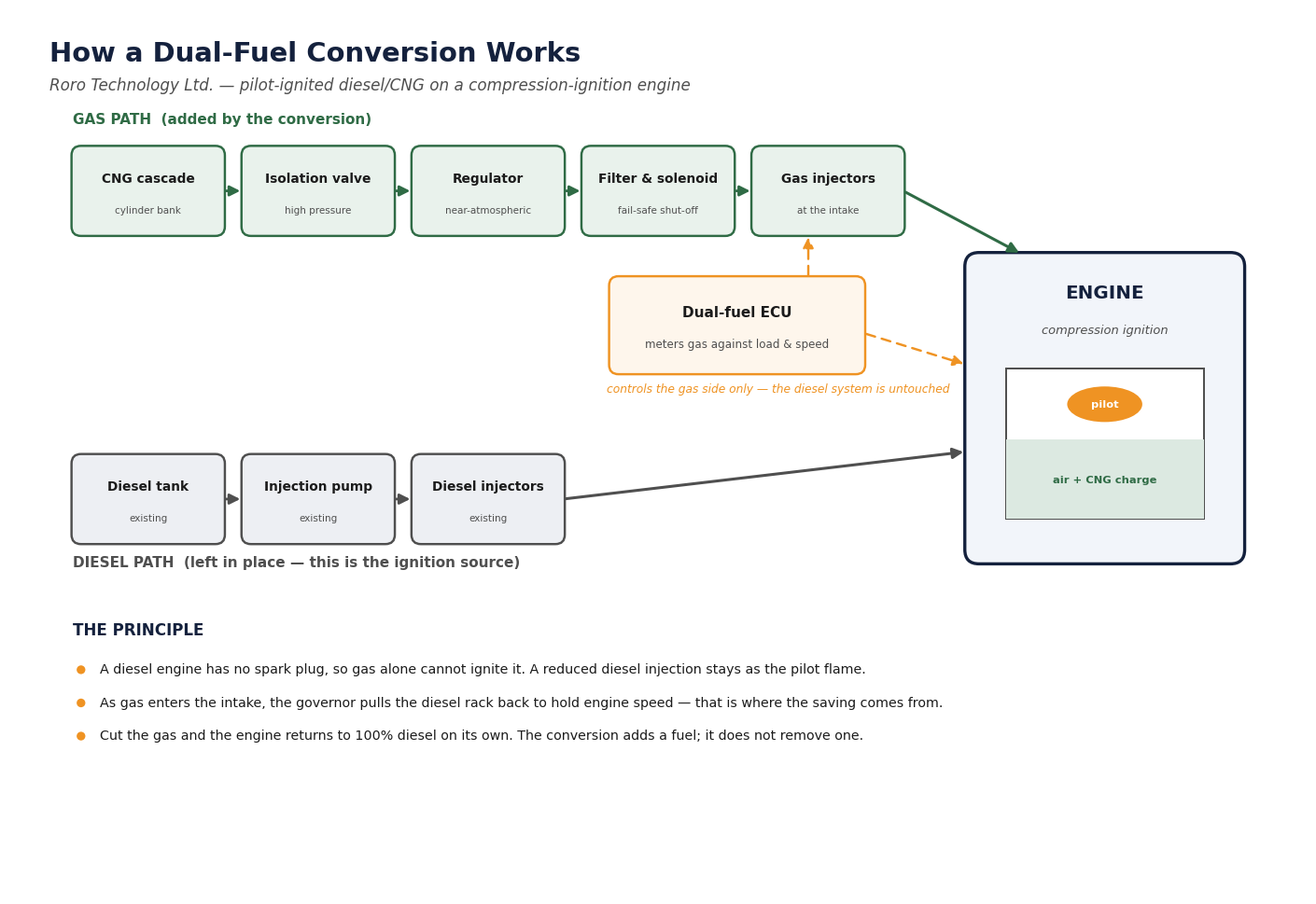
Substitution policy by generator size
| Generating set rating | Recommended CNG / diesel target | Typical fuel-cost saving |
|---|---|---|
| Below 100 kVA | 50% CNG / 50% diesel | ≈38.8% |
| 100 kVA and above | 70% CNG / 30% diesel | ≈54.4% |
Conversion
Truck & fleet CNG conversion
The same dual-fuel principle applied to heavy vehicles — so diesel stops being the largest line in your haulage cost.
A truck engine is a compression-ignition engine like any genset, and it responds to the same pilot-ignition conversion. We fit vehicle-rated dual-fuel systems to trucks, tippers, tankers and haulage fleets: NGV cylinders mounted to the chassis or behind the cab, a regulator and gas train routed clear of heat and road damage, and an ECU calibrated against the vehicle’s real duty cycle rather than a bench figure.
- Diesel remains the fallback. If the vehicle runs out of gas mid-route, it reverts to 100% diesel and keeps driving. A conversion never strands a truck.
- Cylinder capacity sized to your route. Range between CNG stations is the binding constraint on a fleet, so we size storage against the corridors you actually run, not a generic figure.
- Fleet rollout, not one-off jobs. We convert a pilot vehicle first, measure what it actually achieves in service, and only then scope the rest of the fleet against verified numbers.
- Driver and workshop training. Your drivers are trained on refuelling and shut-off procedure, and your own mechanics on what the gas system needs at each service interval.
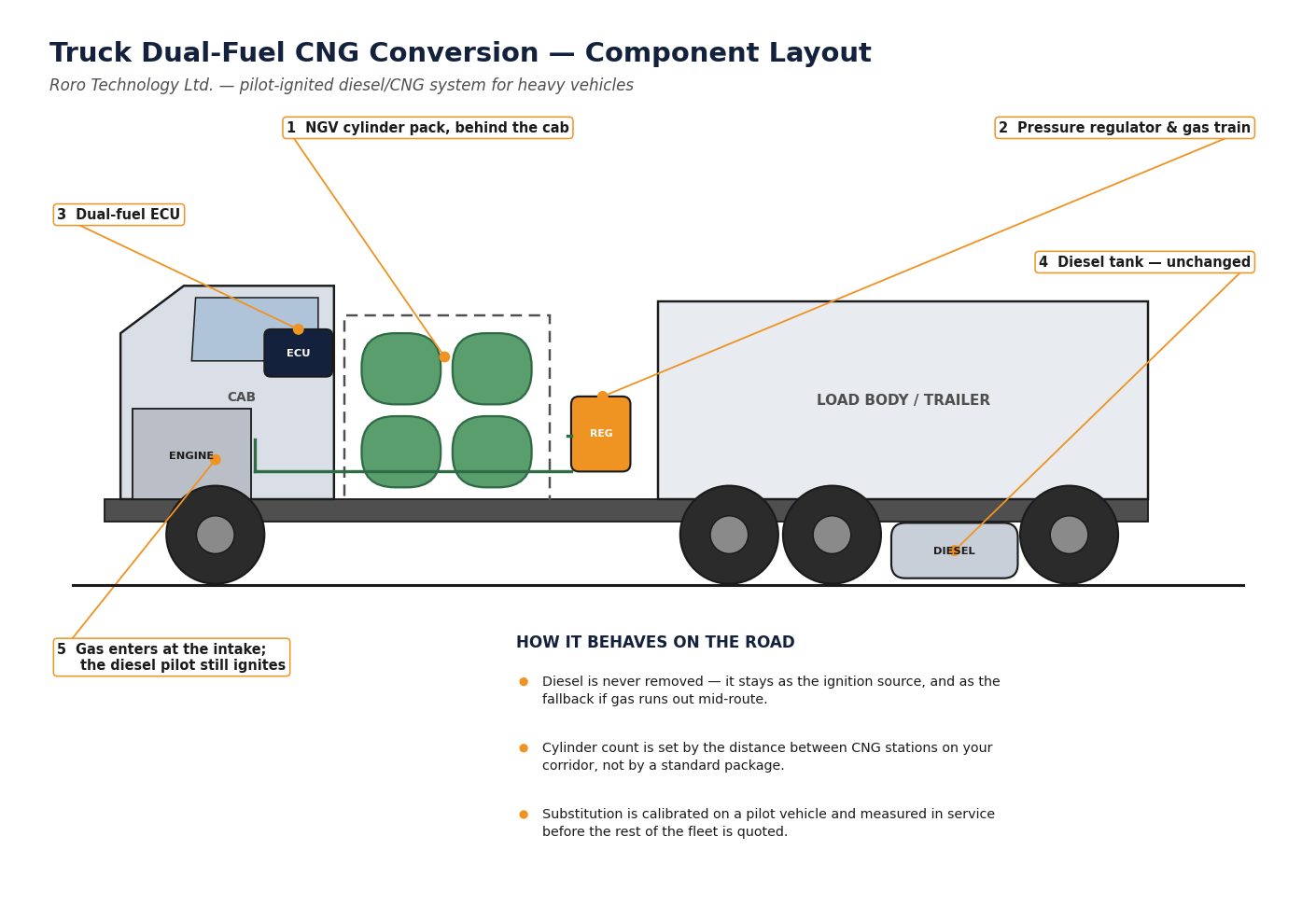
Savings depend on the route. A truck’s substitution ratio varies far more than a generator’s, because load and speed change constantly and refuelling depends on station coverage. We quantify it for your specific routes in a written analysis before quoting — we do not quote a fleet from a percentage.
Infrastructure
CNG cascade & mobile cart
Gas storage on wheels, so you do not need a pipeline at your premises.
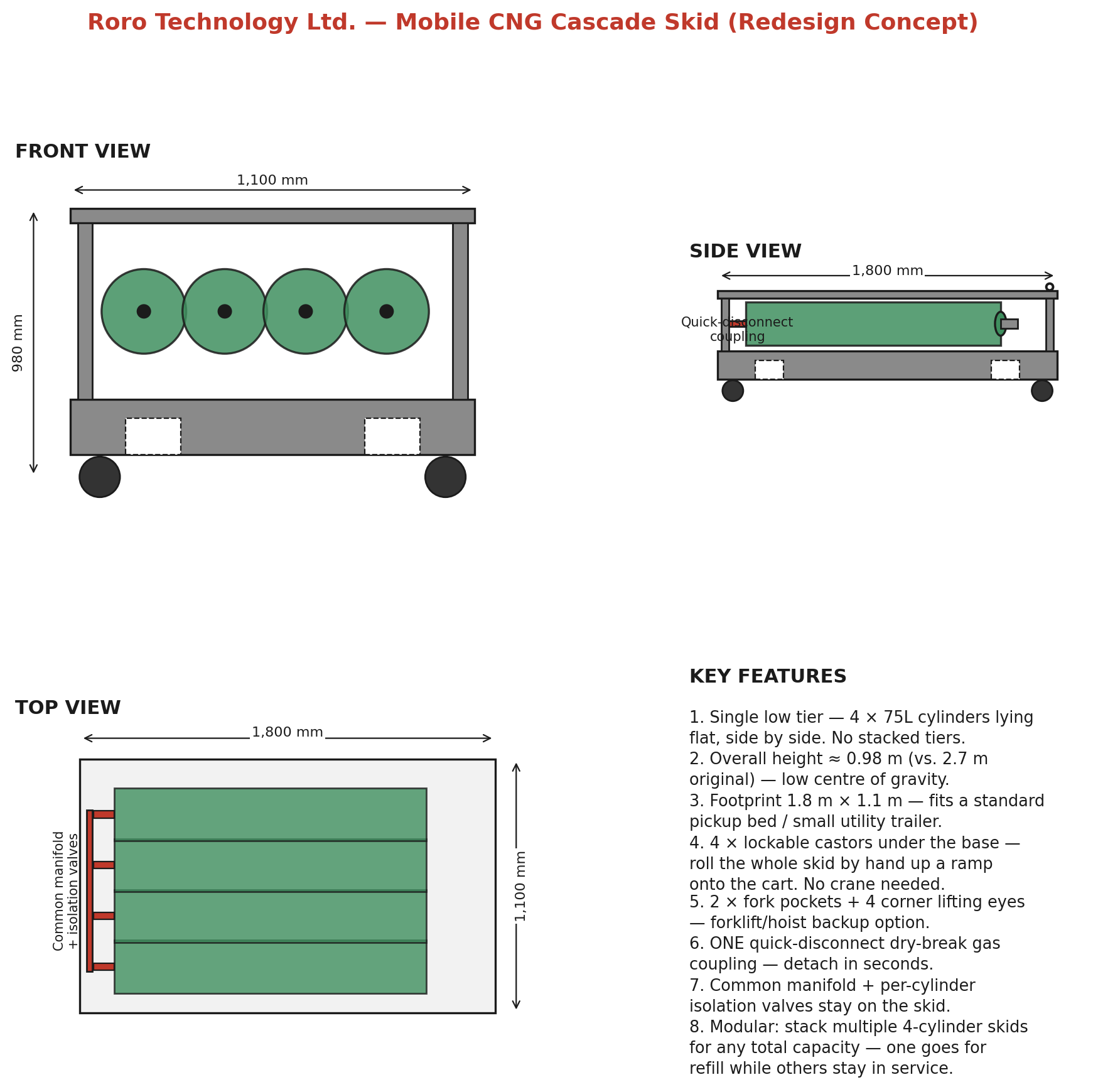
We design and fabricate the cylinder cascade that feeds your converted generator: a bank of NGV-rated 75-litre cylinders on a common manifold, with an isolation valve on each cylinder, a master shut-off, and a pressure relief valve. The whole bank sits on a low-profile skid on lockable castors, on a cart fitted with tyres.
- One cascade can serve multiple generating sets on the same site, avoiding duplicate systems.
- A single quick-disconnect dry-break coupling links it to the generators — released in seconds, self-sealing when detached.
- The frame is built so additional cylinders or skids can be added later as demand grows.
EPC & construction
CNG & LNG stations, built from the ground up
Engineering, Procurement and Construction under one contract — from an empty plot to a commissioned station, with one company carrying the whole plant and the risk with it.
Our flagship work
Plant construction is the largest thing we do and the hardest to buy well. Very few firms in Nigeria can convert the vehicle and build the station that fuels it. That is the whole point of us: we can solve the refuelling problem instead of pointing at it.
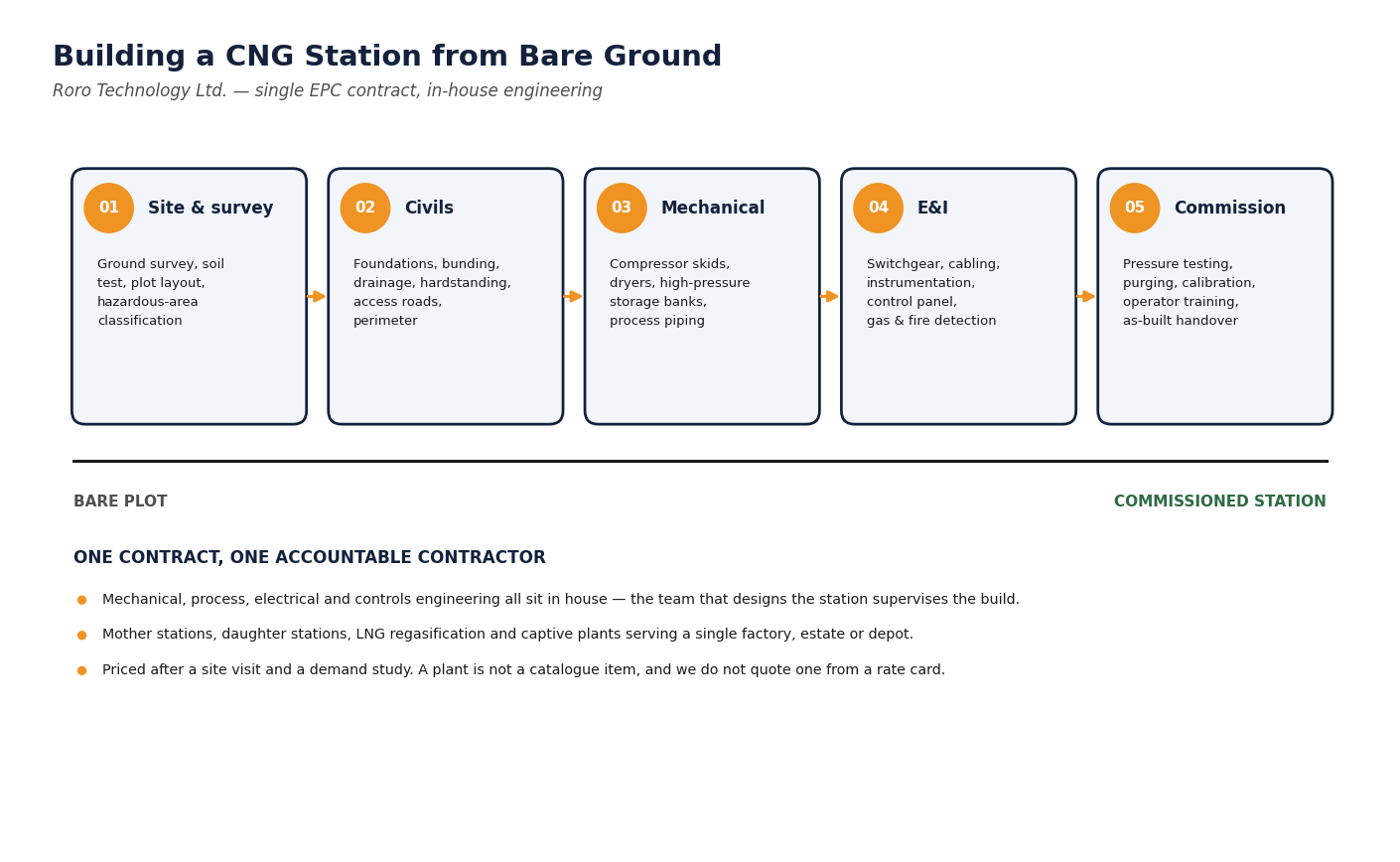
This is the heart of what we do. We take a bare site and hand back a working gas facility: ground survey and civils, foundations and bunding, compression and drying, high-pressure storage, dispensing, piping, electrical, instrumentation and controls, fire and gas detection, commissioning and operator training. One contract, one accountable contractor, one completion date — instead of a designer, a supplier and a builder pointing at each other when something slips.
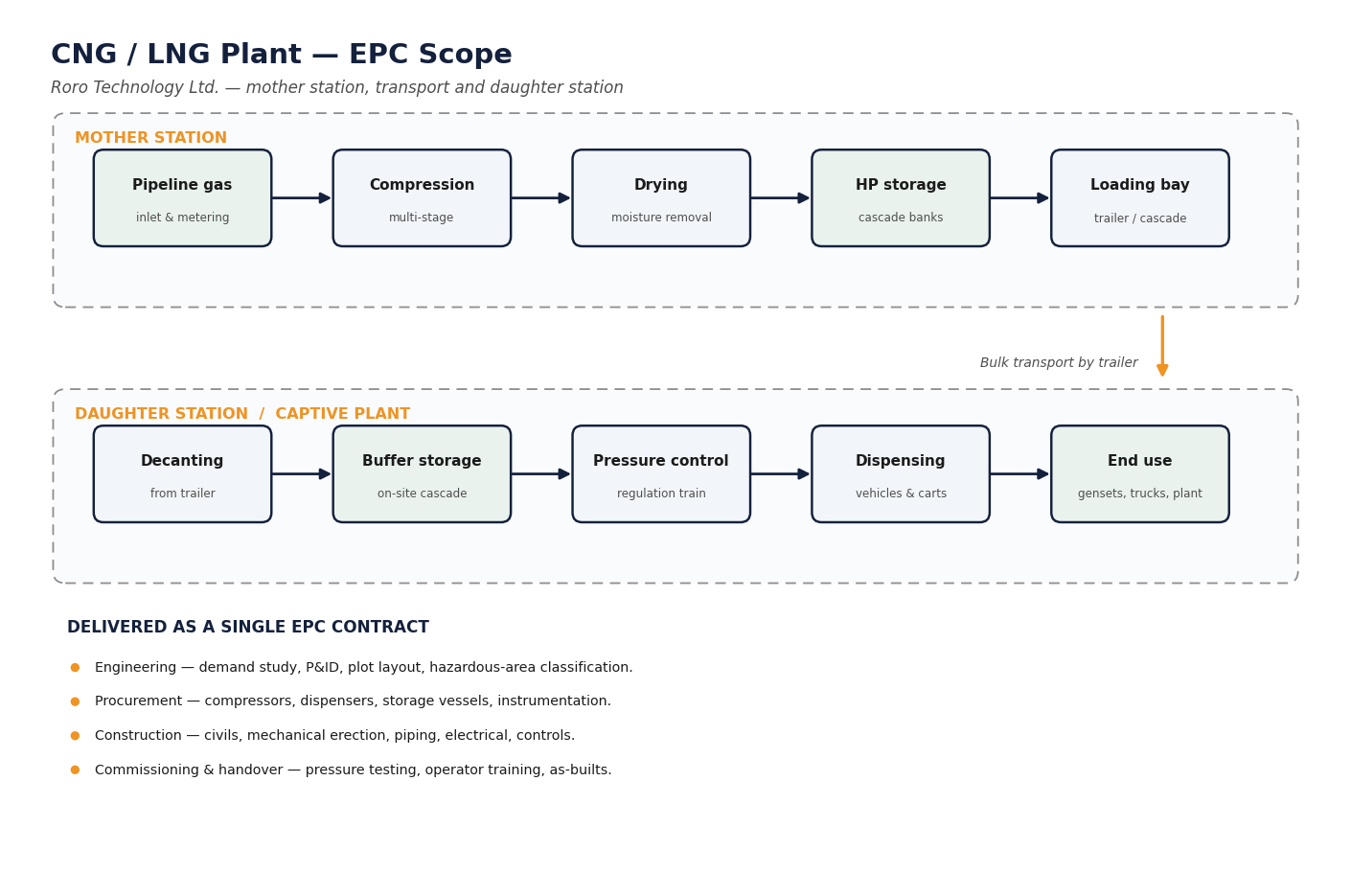
That covers both halves of the gas business. CNG plants compress pipeline gas to 250 bar for vehicles and engines. LNG plants and satellite stations work the cold end instead — gas liquefied at −162 °C, held in cryogenic storage, trucked to sites no pipeline reaches, then regasified back to pipeline-quality gas at the point of use. LNG carries roughly 600 times more gas per unit of volume than the gas phase, which is what makes a site hundreds of kilometres from a pipeline supplyable at all.
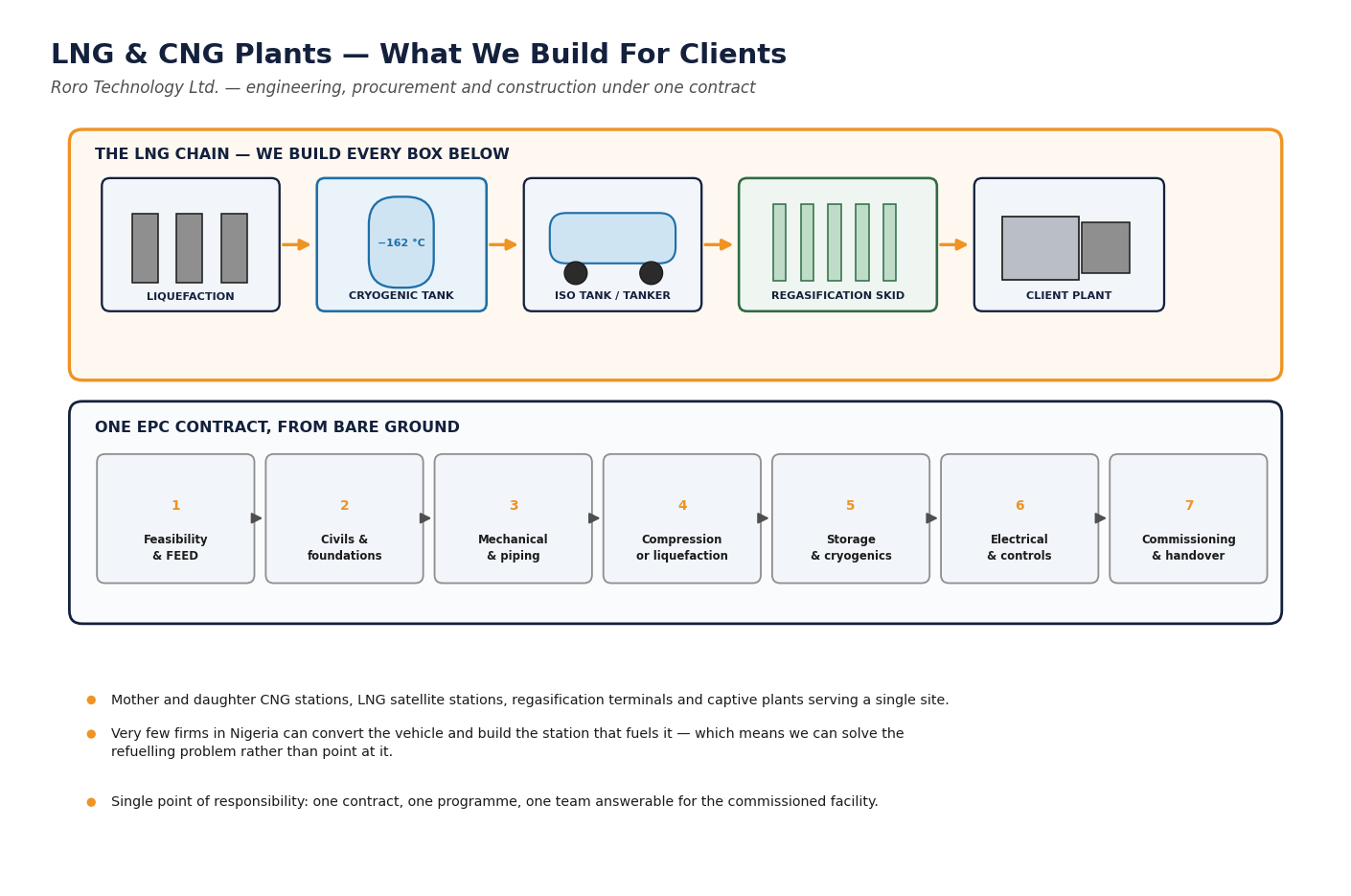
We can do this because the engineering is in house. Mechanical, process, electrical and controls engineers all sit inside the company, so the design, the procurement specification and the people supervising construction are the same team. Nothing is lost in the handover between disciplines, because there is no handover between companies.
What we build
CNG mother stations
Pipeline-fed compression, drying and high-pressure storage, with bay loading for cascades and bulk transport trailers.
Daughter & satellite stations
Decanting and dispensing facilities for sites off the pipeline grid, fed by trailer from a mother station.
LNG storage & regasification
Cryogenic storage, vaporisation and pressure reduction for industrial users who need gas volumes that CNG logistics cannot practically carry.
Captive plants for a single site
Storage, dispensing and gas train serving one factory, estate or plant — sized to that site’s own consumption rather than to a commercial throughput.
How an EPC contract runs
- Engineering — demand study, site survey, process and instrumentation design, plot layout, hazardous-area classification and the safety case.
- Procurement — compressors, dispensers, storage vessels, cryogenic equipment, valves and instrumentation, sourced against the specification we designed rather than what happens to be available.
- Construction — civils, mechanical erection, piping, electrical and controls, pressure testing, and commissioning under load.
- Handover — operator training, as-built documentation, spares list and a maintenance regime your own team can run.
Priced per project. A plant is not a catalogue item — scope, throughput, site conditions and regulatory requirements drive the cost. EPC work is quoted after a site visit and a demand study, not from a rate card.
Equipment supply
CNG equipment & generator supply
Gas generators, skids, cylinders and cascades — supplied, fabricated and commissioned by the people who install them.
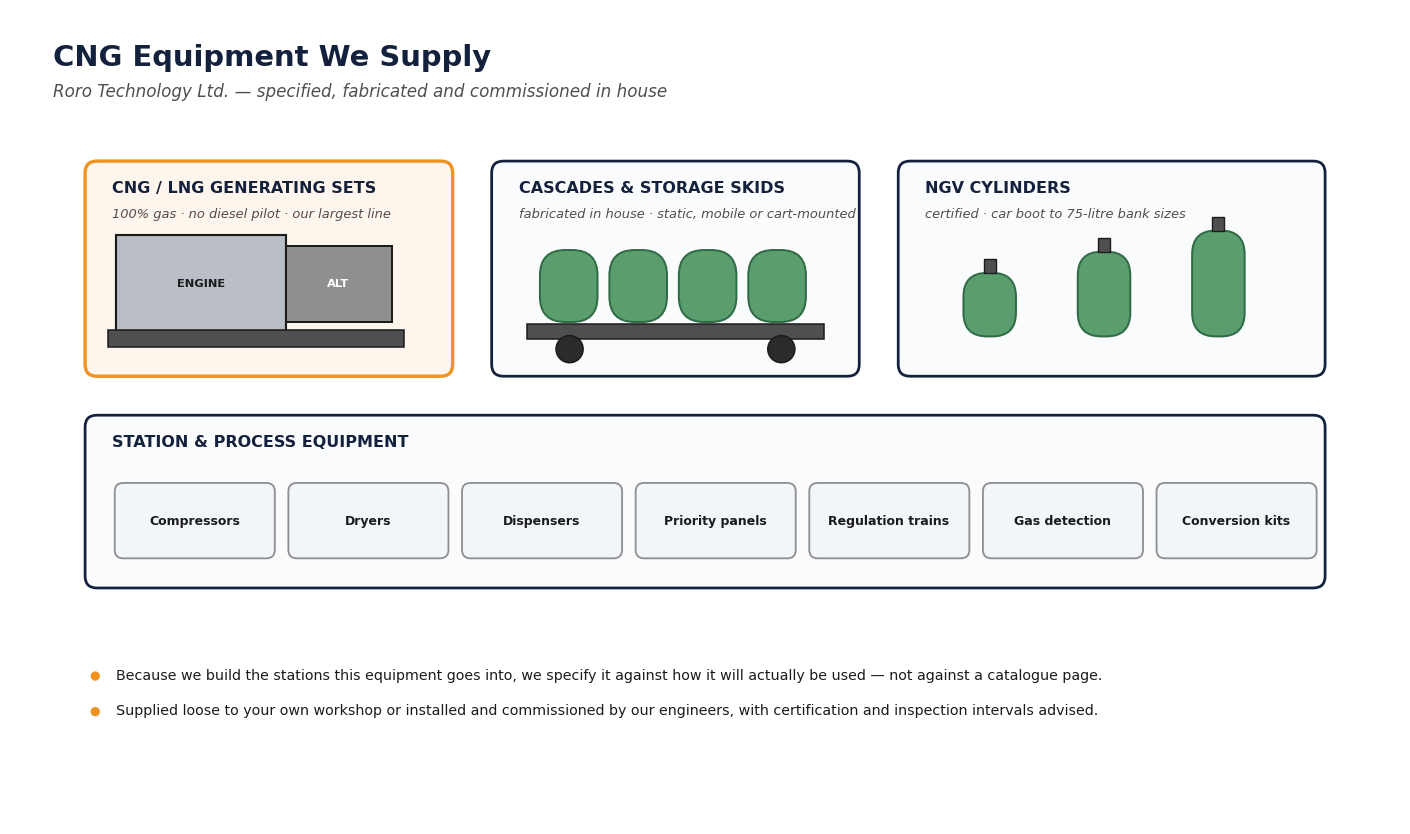
Equipment supply is a large and growing part of our business. Whether you are building a station, expanding a cascade, or replacing a tired diesel set with a machine that runs on gas from the factory, we hold the specification, source it and commission it. Because we also build the plants these parts go into, we specify equipment against how it will actually be used rather than against a catalogue page.
Our largest equipment line
CNG & LNG generating sets
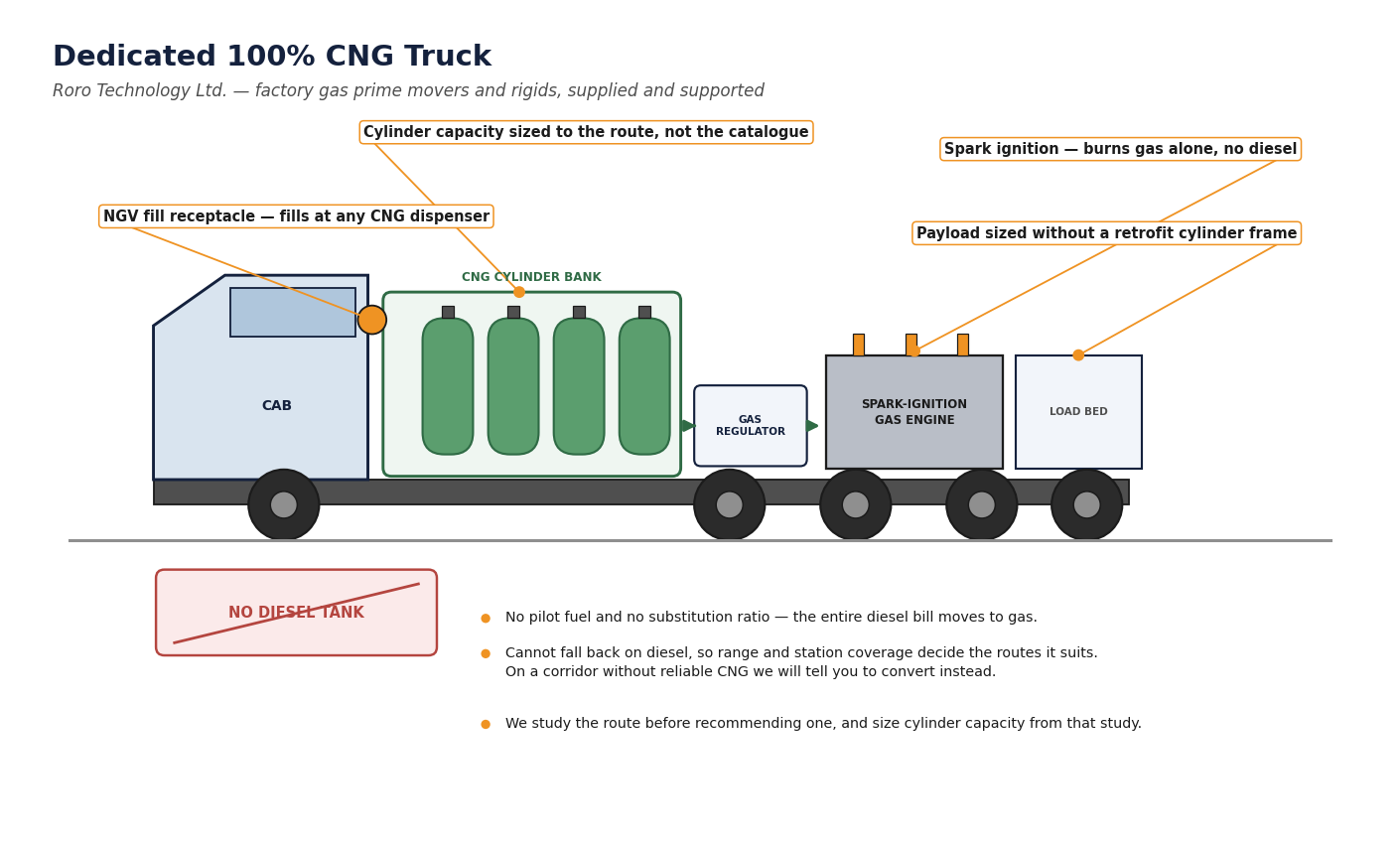
Factory-built spark-ignition gas gensets running on 100% gas — no diesel pilot and no substitution ceiling. We sell a great many of these, in sizes from small commercial sets up to plant duty, supplied with the gas train, storage and controls as one package.
- Sized against your measured load, not your old set’s nameplate.
- Installed, commissioned and load-tested by our own engineers.
Cascades & storage skids
Fabricated in house — frame, manifold, isolation valves, relief protection and quick-disconnect coupling. Static banks for a station, mobile skids on castors, or cart-mounted cascades that a vehicle can tow to a filling point and back.
- Built to your cylinder count and expandable afterwards.
- Pressure-tested and certified before it leaves us.
NGV cylinders
Certified compressed-gas cylinders for vehicles, cascades and station storage, in the sizes that suit the application — from car boot installations up to 75-litre bank cylinders. Valves, brackets and mounting hardware supplied with them.
- Advice on inspection intervals and recertification, not just the sale.
Station & process equipment
Compressors, dryers, dispensers, priority and sequencing panels, pressure regulation trains, filters, solenoid valves and gas detection — specified to the duty and the hazardous-area classification of your site.
- Supplied loose, or installed as part of an EPC contract.
Conversion kits
European sequential dual-fuel kits for diesel engines and bi-fuel kits for petrol vehicles, with ECUs, injectors, regulators and switching hardware — for fleets running their own workshops as well as for jobs we fit ourselves.
- One-year warranty from commissioning.
CNG & LNG trucks
Gas-powered trucks and prime movers for haulage operators moving off diesel — supplied ready to run, with cylinder capacity specified against the corridors you actually run.
- Backed by the same workshop support as our converted vehicles.
We will quote a conversion and a replacement side by side on the same duty cycle where both are viable, so the comparison is yours to make rather than ours to steer.
The two machines that burn no diesel at all
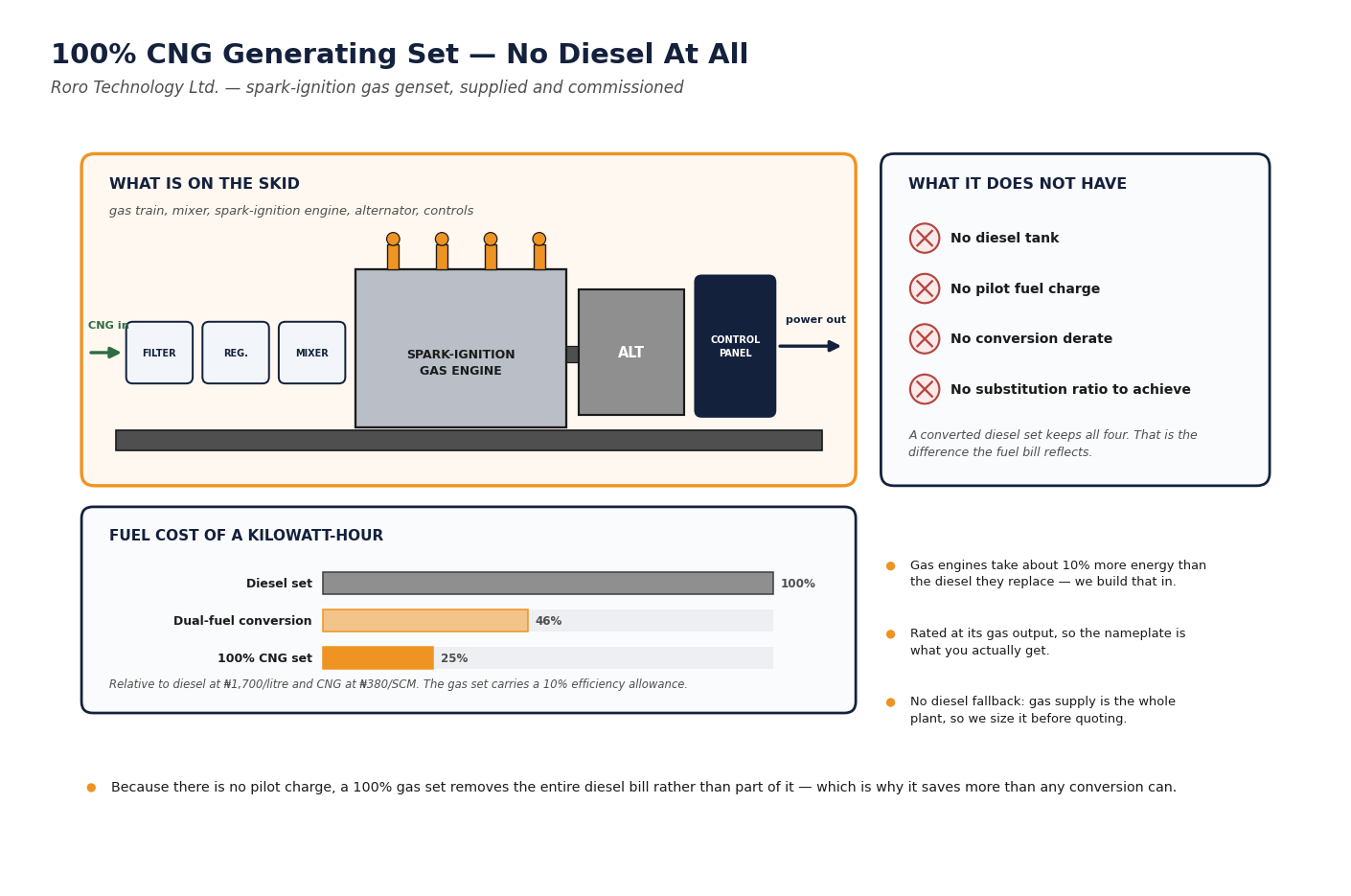
A conversion keeps a compression-ignition engine, so it keeps a diesel pilot charge. These two do not. They are spark-ignition machines that run on gas alone — which removes the whole diesel bill rather than part of it, and is why they save more than any retrofit can. You can model both on our savings calculator.
The full range, by category
Everything below is supplied loose to your own workshop, or installed and commissioned by our engineers with certification and inspection intervals advised. Cryogenic equipment in particular is specified against the duty — insulation, materials and boil-off management are what decide whether an LNG installation works or quietly bleeds its contents to atmosphere.
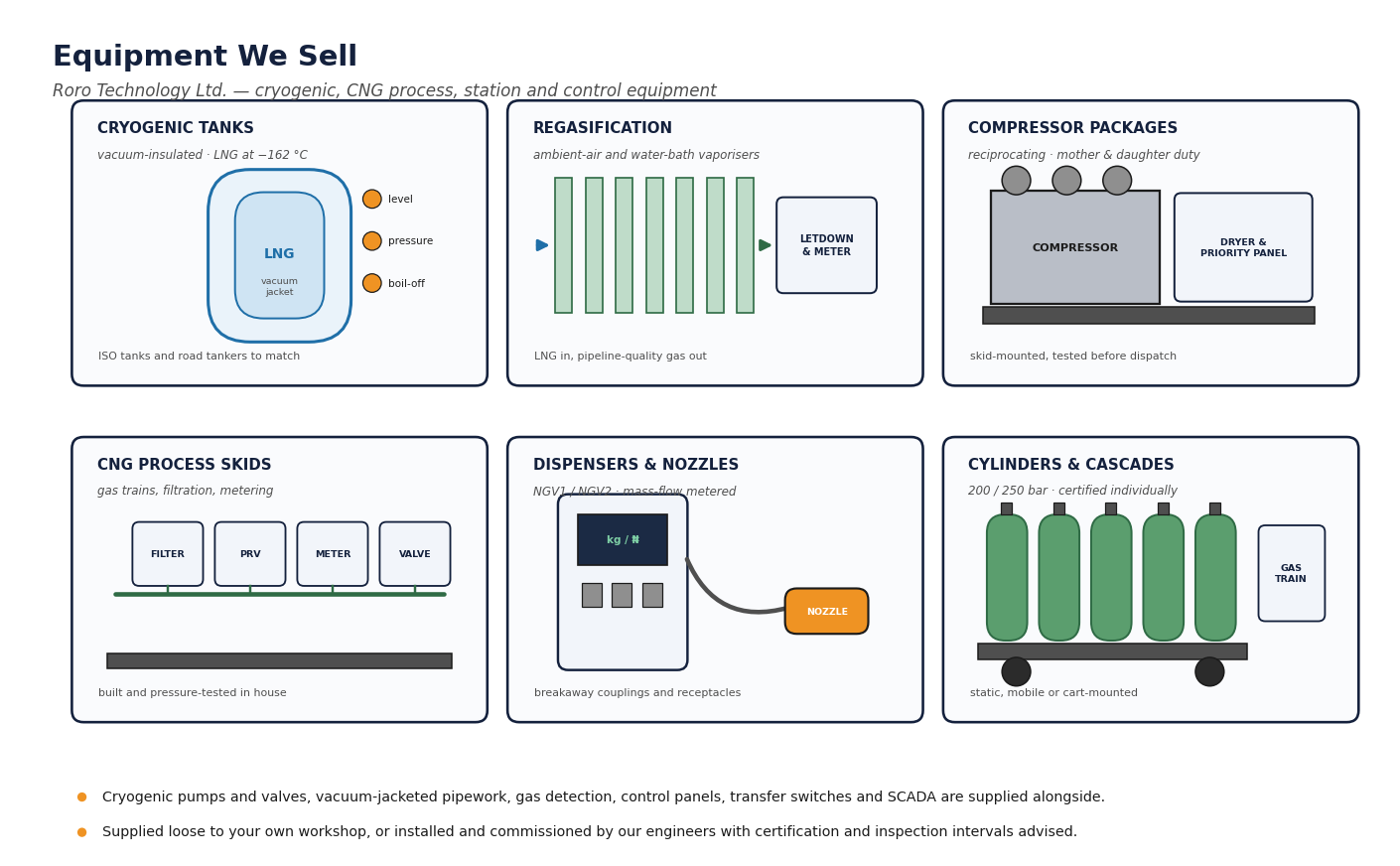
Cryogenic and LNG equipment
For LNG storage, transport and regasification — the cold end of the business, where materials and insulation decide whether a plant works.
Cryogenic storage tanks
Vacuum-insulated vertical and horizontal vessels for LNG at −162 °C, sized from satellite-station scale upward, with level, pressure and boil-off instrumentation.
LNG ISO tanks and road tankers
Intermodal cryogenic containers and tanker semi-trailers for moving LNG to sites no pipeline reaches.
Regasification skids
Ambient-air and water-bath vaporisers with pressure build-up coils, letdown regulation, odorisation and metering — LNG in, pipeline-quality gas out.
Cryogenic pumps, valves and hoses
Submerged and centrifugal cryogenic pumps, extended-bonnet valves, vacuum-jacketed pipework and transfer hoses rated for cryogenic service.
CNG process and station equipment
Everything between the gas source and the vehicle or engine — the compression, storage and dispensing train.
CNG compressor packages
Reciprocating compressor skids with inlet filtration, inter-stage cooling, gas dryers, priority panels and unloading control — mother and daughter station duties.
CNG process skids
Skid-mounted assemblies built and pressure-tested in house: gas trains, PRD assemblies, filtration, metering and priority-fill panels.
Dispensers, hoses and nozzles
Single and twin-hose CNG dispensers with mass-flow metering, breakaway couplings, NGV1 and NGV2 fuelling nozzles and receptacles.
Cylinder cascades and carts
Fabricated in house — fixed cascades and wheeled mobile cascades with manifold, gas train and road tyres, so a site without a pipeline is still serviceable.
Storage cylinders and cylinder banks
Type-I steel and composite cylinders at 200 and 250 bar working pressure, individually certified, in bank or cascade configuration.
Gas-powered machines
Where converting an existing asset is not the right answer, we supply the purpose-built machine instead.
100% CNG and LNG generating sets
Spark-ignition gas gensets that burn no diesel at all. No pilot fuel, no conversion derate, and the fuel bill our calculator models.
Dedicated CNG trucks
Factory gas trucks and prime movers running entirely on CNG, with cylinder capacity specified against the routes actually run.
NGV conversion kits
European bi-fuel kits for petrol cars and SUVs, and pilot-ignited dual-fuel kits for diesel engines — with the ECU, mixer and gas train matched to the engine.
Control and instrumentation
Built in house, so what we install can be measured rather than assumed.
Control panels and transfer switches
Form-built panels, automatic and manual transfer switches, protection and metering, wired and tested before they leave the workshop.
Synchronisation and SCADA
Multi-set synchronisation, load sharing and plant SCADA with remote monitoring of pressures, temperatures, flows and alarms.
Gas detection and safety systems
Fixed methane detection, emergency shutdown logic, flame and heat detection integrated into the plant's trip philosophy.
Not seeing what you need? This is the equipment we hold specifications for and buy regularly — it is not the limit of what we can source. Tell us the duty, the pressure and the medium, and we will come back with a specification rather than a catalogue page.
Systems
Control & automation
The panels, switchgear and monitoring that decide whether your power actually behaves — and whether you find out when it doesn’t.
A converted generator or a gas plant is only half the job. What turns it into dependable infrastructure is the control layer: starting the right set at the right moment, transferring load without a blackout, and telling somebody when a reading drifts. We design, build and commission that layer in house.
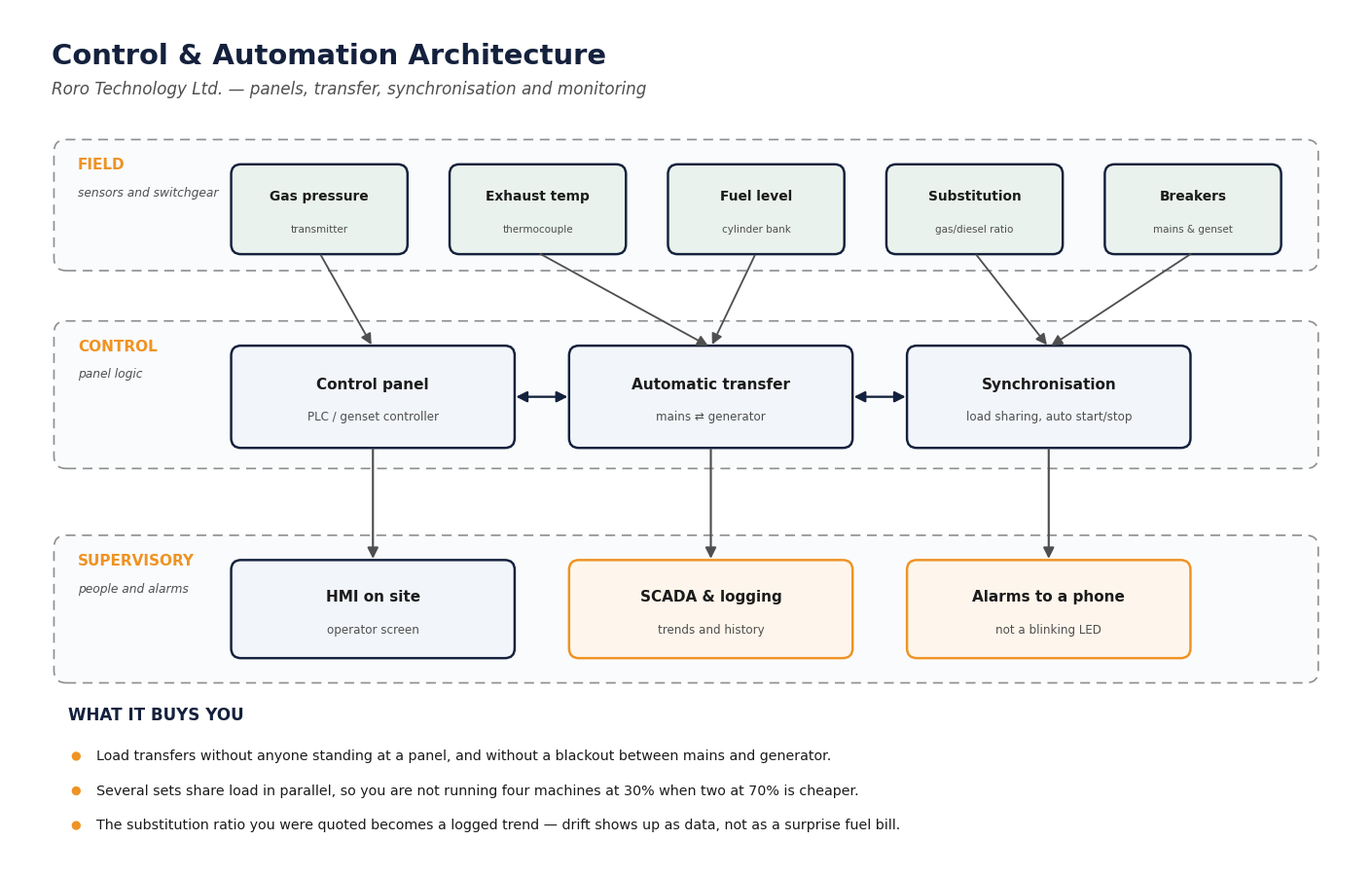
Control panels & switchgear
Built and wired to your single-line diagram — genset control, distribution, protection and metering, labelled and documented so the next engineer can read it.
Automatic transfer switches
Mains-to-generator changeover that runs without anybody standing at a panel, with proper break-before-make sequencing and adjustable delays.
Generator synchronisation
Multiple sets sharing load in parallel, with load-dependent start/stop so you are not running four machines at 30% when two at 70% would do it cheaper.
SCADA & remote monitoring
Gas pressure, substitution ratio, fuel level, exhaust temperature and runtime, logged and visible from a phone — with alarms that reach a person rather than a blinking LED.
Why this matters on a dual-fuel site. The substitution ratio you were quoted is a number somebody has to keep honest. Instrumented and logged, a drift in performance shows up as a trend you can act on. Uninstrumented, it shows up as a fuel bill that quietly crept back towards diesel and nobody can say when it started.
Delivery
Installation, calibration & commissioning
Fitting the kit is the easy part. Calibrating it against your real load profile is what determines your actual saving.
- 1
Site survey
We confirm gas train routing, cascade siting and clearances, ventilation, leak-detection placement, and the safe path for the cart to leave and return to site.
- 2
Mechanical installation
Mixer or injectors fitted upstream of the intake, gas train plumbed and pressure-tested, cascade positioned and coupled, safety systems installed and proven.
- 3
Controller calibration
The dual-fuel ECU is tuned across your actual load band so substitution is maximised where the engine spends most of its time — while protecting the minimum diesel pilot the engine needs for reliable ignition.
- 4
Commissioning & verification
We run the set under load, confirm stable combustion and exhaust temperatures, and record the substitution ratio actually being achieved against the target in your analysis.
- 5
Operator training
Your own staff are trained on start-up and shut-down, the refill routine for the cascade and cart, and what to do if gas supply is interrupted — the engine simply reverts to 100% diesel.
Aftercare
Servicing & ongoing support
A dual-fuel system needs periodic attention to keep delivering the saving it was commissioned at.
- Substitution verification — we re-check the CNG share you are achieving against the commissioning benchmark, so a drift in performance is caught rather than quietly absorbed.
- Gas train inspection — leak testing, filter servicing, regulator and solenoid checks, and cylinder valve inspection.
- Recalibration — if your load profile changes materially, the controller can be retuned to suit the new duty cycle.
- Cascade expansion — additional cylinders or skids fitted to the existing frame as your gas demand grows.
- Cylinder recertification support — we advise on periodic inspection intervals for NGV cylinders and coordinate testing.
Commercials
How a generator conversion is priced
Conversion kit
Priced per generating set, according to its rating. Smaller sets take a smaller, lower-cost kit.
Installation & calibration
Priced per generating set. Covers mechanical fitting, commissioning and operator training.
CNG cylinders
Priced per 75-litre NGV-rated cylinder. We recommend a quantity based on the autonomy you need between refills.
Cascade & cart
One shared, wheeled cascade assembly per site in most cases — sized to the cylinder count and built to expand.
Nigerian VAT at 7.5% applies to all quotations. Work commences on receipt of payment and a final invoice is issued on completion of installation.
Ready to cut your generator fuel bill?
Send us a photo of your generator nameplate and we will prepare a written technical and financial analysis for your specific set — including projected savings at your actual running hours.
Or email sales@rorotechnologies.com